
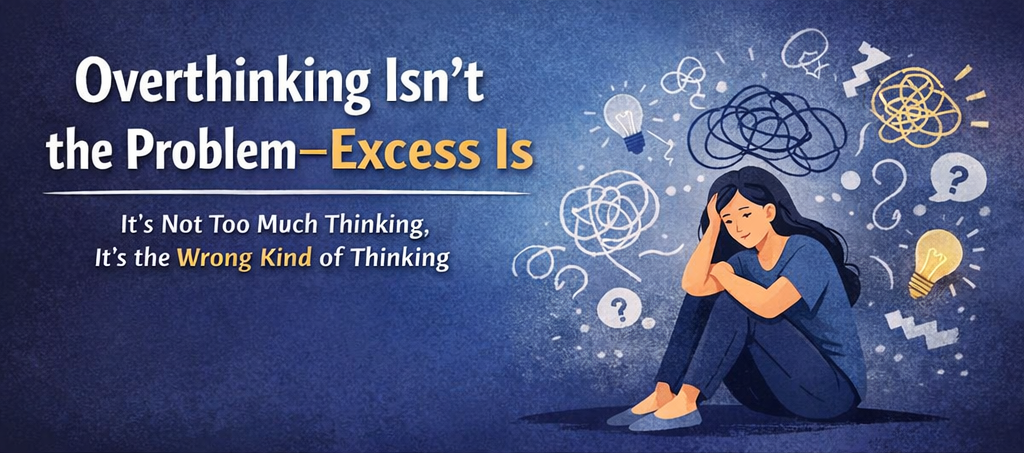

The term Overthinking is commonly heard in present times. People use it in a way to express their personality. This term can be used by people in different contexts and with different emotions.

Different Emotional Uses of Overthinking
For instance, sometimes it's used as concern (I am afraid of your overthinking nature), frustration (I am tired of your overthinking), and sometimes it's used as disappointment because overthinking is generally observed as negative in nature.
The Common Misconception
It is commonly believed that thinking too much about something is harmful and should be avoided. Here's the actual idea of this article, which is misleading or misunderstood.
Core Argument: Wrong Thinking vs Overthinking
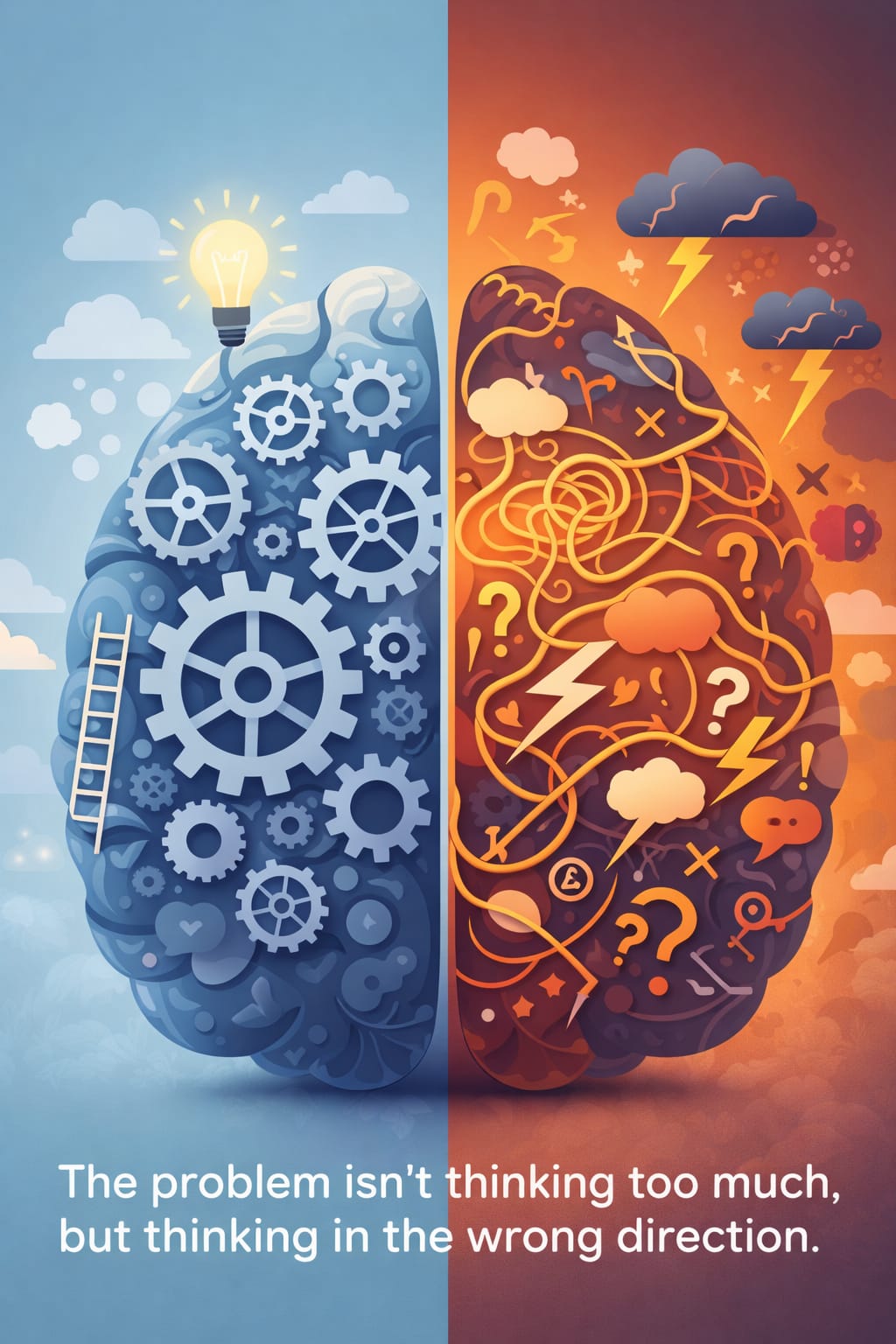
One should understand that the real problem is not overthinking but wrong thinking. In simple words, the quantity of thinking is not harmful, but the quality and direction of thinking are mainly responsible.
Understanding Thinking and Overthinking
To understand the actual problem, we first need to understand the meaning of thinking and overthinking.
Meaning of Thinking
Moving to thinking, it refers to the mental process or cognitive engagement with an issue. It is basically how we analyse, process, and understand different scenarios.
Meaning of Overthinking
Overthinking is just the reciprocal of thinking; it is simply called repetitive thinking or excess of thinking.
Major Problems Associated with Overthinking
People are also afraid of overthinking because it leads to the following three major problems:
1) Stress and Worry
(Overthinking can lead to stress or worry as it makes you anxious, uncomfortable, or less cooperative.)
2) Prevention of Practical Action and Decision Making
(For example, if a family member suddenly falls ill, instead of acting instantly, one starts thinking about which hospital is best, which is near, or whether they might make a wrong decision in choosing a hospital, etc.)
So here, overthinking prevents practical action and decision making.
3) Feeling of Being Unproductive and Useless
(As a person is overthinking on a particular topic, but in the end, after putting all their mental effort and energy, they do not arrive at a conclusion or solution.)
The Misinterpretation of Thinking Limits
So, behind these harmful effects of overthinking, many people assume that there is a limit to thinking and one should think within that limit. Once the limit is crossed, it becomes harmful. However, this opinion ignores a distinction between rigid thinking and wrong thinking.
Types of Wrong Thinking
A) Asking the Wrong Type of Questions
This happens when a person tries to understand a situation using inappropriate approaches. For example, if someone wants to understand the meaning of friendship in terms of utility, numbers, or values, then they can never understand the true meaning of friendship in life. Similarly, trying to explain market trends using the laws of physics would only create confusion and nothing else.
In daily life, if a person interprets emotional situations using logic, deep analysis, and overestimation, it will only complicate their understanding and make it unclear.
B) Asking the Right Questions at the Wrong Time
This is something that is experienced and understood by each one of us in some aspects of life. Many people ask logical and correct questions during inappropriate situations.
For instance, if the father of Sam is hospitalized and during this time he asks his mother to go travelling just to refresh their minds. Similarly, if a friend is in emotional distress and needs immediate support and guidance, instead of this, their peers take the situation lightly and ask him to come watch a movie in the mall.
So in such cases, the thinking is not wrong, but the timing is incorrect.
Consequences of Wrong Thinking
These above-mentioned forms of wrong thinking often lead to negative effects in one's life such as frustration, worry, fear, anxiety, stress, guilt, and much more. Further, it deteriorates one's health and overall well-being.
Also, when we ask the right questions during inappropriate situations or at the wrong time, it leads to dilemmas and unwanted conclusions, which give way to self-doubt. When we think at the wrong time, we miss important opportunities to act, which in the future leads to regret and guilt.
Even a small amount of wrong thinking can have diverse harmful effects. For instance, if someone delays a situation that requires urgent action due to overthinking, it could have hazardous and emotionally distressing consequences.
Understanding Right Thinking
On the other hand, right thinking involves asking the right questions at the right time. It does not necessarily mean that the questions are purely perfect and precise, but rather regulating our thinking in a relevant and meaningful way.
Benefits of Right Thinking
Right thinking can help in various ways, such as understanding situations better, making informed decisions, and acting in an appropriate way. It also allows one to explore and gain new insights about themselves and the world, which are essential aspects of human life.
Individual Differences in Thinking
But most importantly, right thinking does not guarantee that everyone will arrive at the same conclusion or answers. Different individuals can have different viewpoints on the same topic, based on their own perspective, understanding, culture, and traditions. These individual differences are a natural part of the thinking process.
Thinking vs Immediate Productivity
Another important aspect is that thinking does not promise to produce immediate results. In the modern era, we often associate thinking with productivity and action. But thinking can also be contemplative, meaning it is done for the sake of understanding rather than producing something useful.
People take this for granted. Sometimes deeply thinking about life, experiences, or abstract ideas does not lead to immediate action, yet it enriches our understanding and leads to fruitful insights. For example, if someone is reading a book to gain new insights, it may not produce a direct outcome, but it still holds significant value.
Challenging the Idea of “Too Much is Bad”
This article also challenges the idea that "Too much of a good thing is always bad." It argues that there is no such concept as excessive thinking if the thinking is done correctly.
People often criticise "thinking in circles" because it can lead to anxiety due to repetitive thinking. However, such thinking is not harmful unless it interferes with other aspects of life. The only real issue arises when thinking turns into obsession, restricting an individual from managing other responsibilities and work.
Final Understanding
Eventually, the conclusion is clear: the problem is not overthinking, but erratic or misguided thinking. A sudden halt to thinking is not the solution; instead, we should focus on the way we think by asking relevant questions according to the scenario and maintaining a balance between reflection and action. Thinking, when done properly, is not a weakness but a strength.
Conclusion
Overthinking is misunderstood as the main problem, but actually the main issue exists in how we think. Wrong thinking involves irrelevant questions or poor timing, which adds to stress and inactivity.
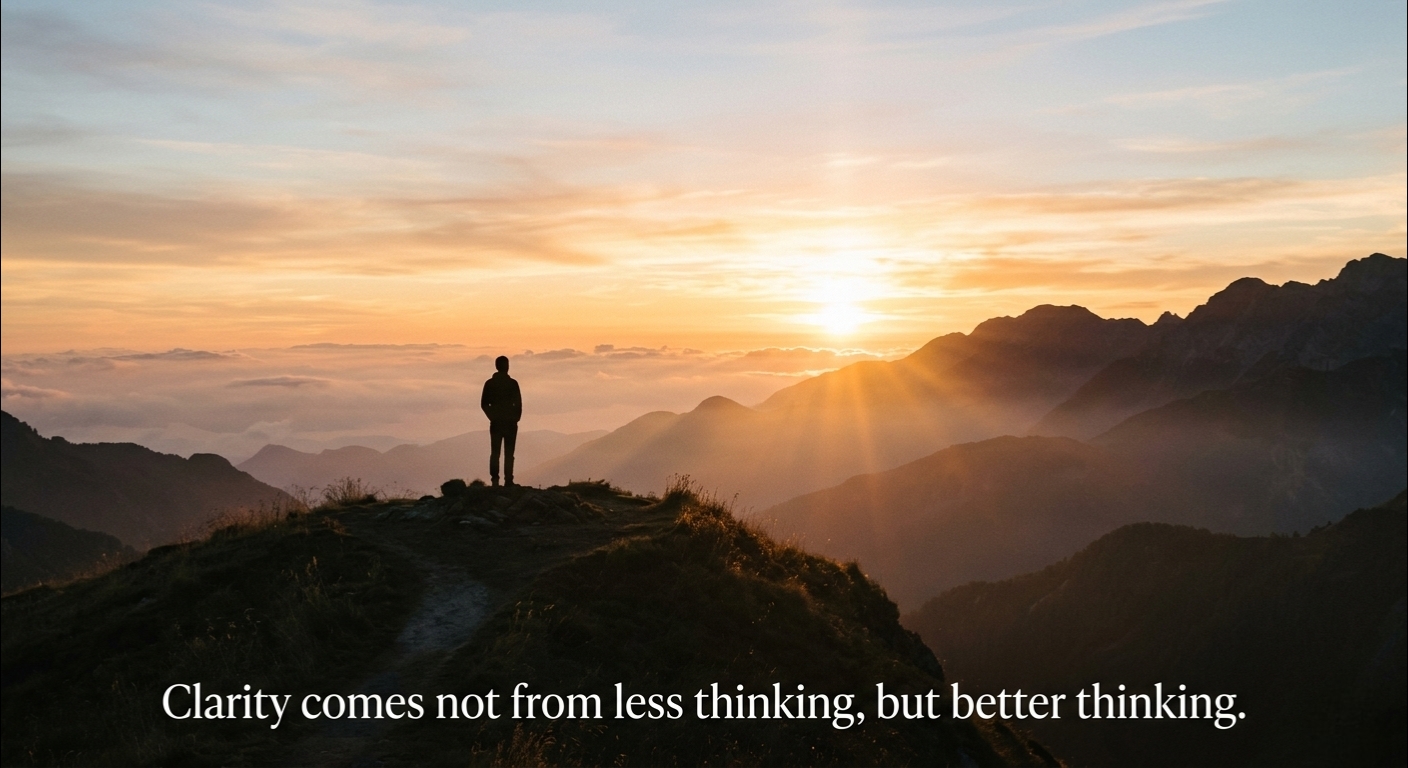
On the other side, right thinking not only enhances understanding and decision-making quality but also creates an impact on overall personality. Therefore, instead of reducing the amount of thinking, we should aim to refine the pattern of thinking.
The goal is not the quantity of thinking but the quality of thinking.